

“Successful ventures are not just imagined; they are tested, validated, and refined through feasibility analysis.”
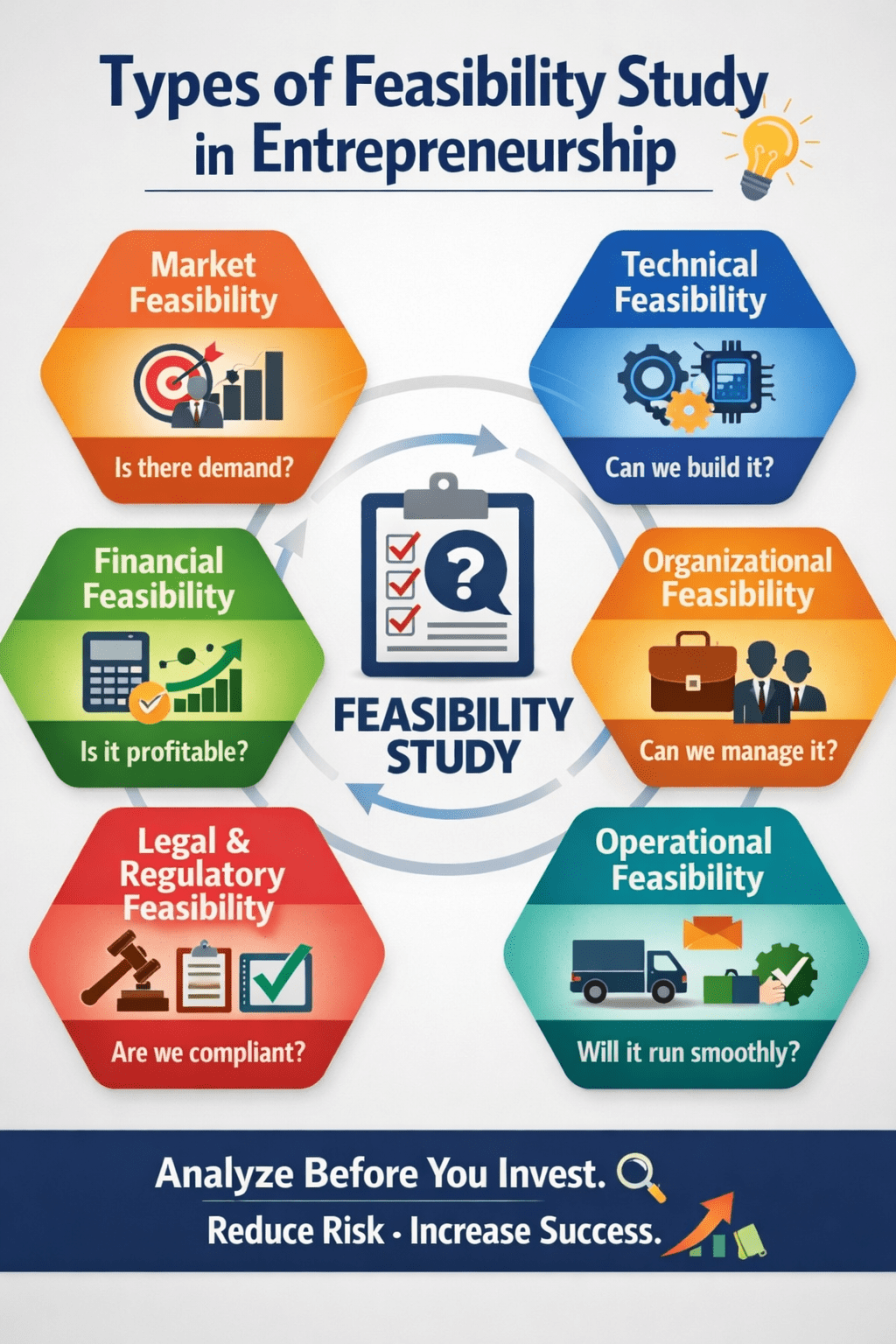
Before investing time, money, and resources into a new venture, entrepreneurs must answer one critical question: Is this business idea viable? This is where types of feasibility study in entrepreneurship become essential. A feasibility study helps founders evaluate risks, opportunities, and practical limitations before launching a startup, ensuring decisions are backed by data rather than assumptions.
Below are the most important feasibility study types every entrepreneur should understand to build a strong foundation for long-term success.
1. Technical Feasibility Study
Technical feasibility assesses whether the business has access to the technology, infrastructure, and expertise required to deliver its product or service. This includes evaluating systems, tools, production processes, and scalability.
Entrepreneurs should consider:
- Availability and reliability of technology
- Technical skill requirements
- Long-term scalability and integration
This study is particularly important for technology-driven startups such as mobile applications and digital platforms.
2. Economic (Financial) Feasibility Study
Economic feasibility determines whether the business idea is financially viable. It is one of the most critical business feasibility components, focusing on costs, revenue potential, and profitability.
Key areas include:
- Initial investment and operating costs
- Revenue projections
- Break-even analysis and ROI
For startup feasibility, this study helps entrepreneurs decide whether the idea can attract funding and sustain operations. Many founders strengthen this stage by engaging expert support for feasibility study services.
3. Market Feasibility Study
Market feasibility evaluates the demand for the product or service. It analyzes market size, customer segments, trends, and competitive dynamics.
This study answers questions such as:
- Who are the target customers?
- What problems does the business solve?
- How intense is the competition?
Market feasibility is especially critical in experience-driven sectors like wellness, beauty, and hospitality.
4. Legal and Regulatory Feasibility Study
Legal feasibility ensures compliance with applicable laws, regulations, and industry standards. It covers licenses, permits, intellectual property, and regulatory obligations.
For example, wellness and beauty businesses often face strict compliance requirements related to consumer safety, data privacy, and service standards.
5. Operational Feasibility Study
Operational feasibility examines whether internal processes, resources, and workflows can support the business model. It evaluates staffing needs, supply chains, systems, and management structures.
This study ensures that the business strategy can be executed efficiently in real-world conditions.
6. Schedule Feasibility Study
Schedule feasibility determines whether the project can be completed within a realistic timeframe. Missed timelines can increase costs and weaken competitive advantage, especially for startups entering fast-moving markets.
Apeiron’s Expertise Across Diverse Feasibility Project
Apeiron Market Research and Consulting bring hands-on experience across diverse industries, helping entrepreneurs validate both digital and physical business concepts through tailored feasibility studies.
For a wellness and beauty mobile app, Apeiron has supported feasibility assessments by analyzing consumer behavior, app adoption trends, competitive digital platforms, monetization models, and financial forecasts. This ensures the app concept aligns with user expectations while remaining commercially viable in a crowded app ecosystem.
In contrast, for a board game café, Apeiron’s feasibility approach focuses on location-based market demand, competitor cafés, customer experience preferences, pricing strategies, operational workflows, and revenue models combining food, beverages, and gaming experiences. These insights help founders understand footfall potential, break-even timelines, and long-term sustainability.
Across such varied projects, Apeiron’s feasibility study services typically assess:
- Entrepreneurship viability
- Market & economic overview
- Competitor landscape
- Consumers’ behaviour
- Market entry strategies
- Business modelling
- Financial forecasts
- Business & marketing strategies
Entrepreneurs exploring similar ideas can integrate a link to feasibility study services within their planning process to access expert-led insights.
Conclusion
Understanding the types of feasibility study in entrepreneurship allows entrepreneurs to reduce uncertainty, manage risks, and validate ideas before launch. By combining multiple feasibility study types – technical, financial, market, legal, operational, and schedule, founders gain a complete view of startup feasibility.
When supported by experienced consultants who understand both digital products and physical business models, feasibility studies become a powerful tool for turning innovative ideas into sustainable, successful ventures.

